Showing posts with label nazism. Show all posts

Wednesday, August 13, 2014

Book Review - Nazi Wireless Propaganda by M.A. Doherty

Fascinating history of something that should be more widely known.

I wasn't sure what to expect upon receiving this book but this account of Lord Haw Haw, Goebbels, and their associated goons was a very good read. Doherty writes well and, although he does run on at times, makes for a very good account of German propaganda. Not long ago I had learned of the existence of a New British Broadcasting Company NBBC ran by the Germans but found very little about it. This book covers great detail about it and other projects upon which the Nazis pretended to be illegal British radio stations protesting the war. This tactic would be marvelously spun around by Sefton Delmer and played on the Germans even better.

For WWII "buffs", armchair historians, and people interested in the history of propaganda, I highly recommend this book. It is not dry nor is it bogged down with minutiae of detail. Doherty focuses on the people involved in the history and the effect that the events had on them (and the effect they had on the events). So many histories and historians focus on events and ignore people. Doherty does not.

If I have any complaints about this book, it is too short! Barely weighing in at 200 pages, it seems to me that this book could have been easily twice the size without losing any of its interest or readability. Get this book while it is still available if anything WWII or propaganda interests you at all!

Monday, August 11, 2014

Book Review: The Occult Reich by J.H. Brennan

The Charles Berlitz of World War II

To preface this review, I have read Nicholas Goodrick-Clarke's books on the Nazis and the Occult as well as Dusty Skylar's "The Nazis and the Occult." Goodrick-Clarke comes from the point of view that, of course, the occult is just a bunch of hokum but certain Nazis believed it and acted on some of the weird and twisted beliefs they found there. Goodrick-Clarke is very skeptical, as other Historians are, that Hitler took the occult truly seriously other than the effect it had to bolster his own claims to power.

Skylar takes a middle road and writes that the Nazis exploited the occult and maybe there is something in it. However, Skylar is quite clear that if there is "something in it", it is psychological magic instead of paranormal magick. Indeed, Skylar compares Hitler's movement and persona to recent evil cult leaders and the mesmeric effect they had on their followers.

Brennen, a prolific writer on occult matters, is far to the other side. For Brennen, Hitler was an experienced Satanist who focused his magical energies for his own evil ends. Himmler was not the master occultist of the Third Reich, it was Hitler. And to Brennen, this occult stuff is very, very real. His book, small and short and looking like one of the Charles Berlitz books about the Bermuda Triangle is written in a fantastical tabloid style with long digressions to show where Hitler may have got his evil satanic teachings. Crowley and Gurdjieff are mentioned although not directly linked to Hitler. As, in Brennen's world view, Crowley and Gurdjieff were mages with genuine powers, they are just compared to how Hitler himself had powers of precognition and reality bending with his will.

While this book expects the reader to approach from the point of view that all occult and paranormal phenomena are real, it is very well written. It is actually quite an enjoyable read. Written in 1974, it is quite dated but is often still quoted to this day by other authors. I even saw Brennen himself interviewed in a documentary on Hitler and the Occult (alongside Skylar and Goodrick-Clarke).

I recommend this book (if you can get a copy) more for the entertainment value. Its written well and is a fascinating read. Making Hitler into a Voldemort superman is, in my opinion, much more credit than the little twerp deserves, but who knows? (insert twilight zone musical cue here :-)

Sunday, August 10, 2014

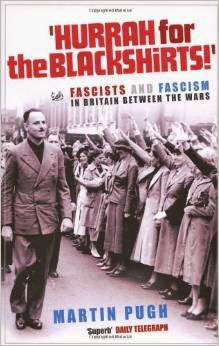
Book Review - Hurrah for the Blackshirts!: Fascists and Fascism in Britain Between the Wars

More of an in depth history of Britain between the wars.

Pugh's book is very thorough and well written. At times, his prose is very thick and somewhat hard going to read as he is a historian and writes in a dense scholarly matter. However, the writing is lively and active and it is not boring.

"Hurrah for the Blackshirts" is less of a story of Oswald Mosley, William Joyce, and others of that ilk and more of a socio-political history of Britain between World War I and World War II. Pugh goes into depth on various economic matters, political matters, bringing up hundreds of names and people in passing. Large sections of the book discuss current events of the time with little to no reference to any fascists at all. In fact, there is a chapter of the book that details British policy in India at this time which seems totally out of place. Pugh seems to realize this as well, seeing that he's thread-jacking his own book, he kept putting in throwaway references to Mosley through this particular chapter with such phrases like "Mosley disapproved of this" or "Mosley agreed with that."

Luckily, the book gets back on track in the final chapters (the best) which really focus on the fascists. William Joyce (the Infamous "Lord Haw-Haw" is only mentioned in passing with other fascists but Pugh really focuses on Oswald Mosley and much can be learned about him here. While making no conclusions, Pugh portrays him as a self-absorbed playboy more concerned with building up his personal legend than actually trying to make fascism happen in Britain.

A personal observation of mine though is that, like most 'mainstream' historians, Pugh totally ignores the pseudo-religious background to most of the fascist movements of Europe. This has been written about by such writers as Dusty Skylar and historians such as Nicholas Goodrich-Clarke. Even art historians such as Johnathan Meades talk of it. The Nazis especially were highly influenced by their strange own occult beliefs that convinced them of the demonic in-humanness of their victims and allowed them to slaughter them all the more because of it. 


 Pugh sidesteps these beginnings although refers in a number of occasions to the "romantic nationalist ideas" of National Socialism and fascism in general. While Pugh and others may see the idea of the Aryan descending directly from heaven and inhabiting Atlantis among the "beast-men" as ridiculous (which it is), these ideas did in fact make these fascists do what they did. 

Himmler and Hess were fundamentalist believers in their occult view of the world, a view which, while ludicrous, made them do the crimes against humanity which they did. Simply pretending that the pseudo-occult motivations of the Nazis and other fascists didn't happen because its too weird is just Pugh being careful among his fellow mainstream historians.

Friday, August 8, 2014

Book Review - To Die For Germany: Heroes in the Nazi Pantheon by Jay W. Baird


A book with a split personality.
This book is well written and is an easy and good read. It seems to actually be two books in one though. The first part of the book is indeed about Nazi "heros" who were killed early on in the Nazi Movement in Germany such as Horst Wessel the Ur-Skinhead (I think he is who Elton John's song about Saturday night is alright for fighting is written about) and the sixteen "immortals" who were gunned down during the abortive attempt to overthrow the Government of Bravaria in 1923.

Each chapter contains an account of a different subject, however, after a few chapters, the book suddenly changes content and tone. The middle and final chapters are no longer about Nazi's who died but goes over to talking about Nazi aesthetics, poetry, and propaganda. Indeed, there are pages and pages of Nazi poetry about death and mother's loss until you start getting weepy-eyed for the fallen German SS soldiers. It snaps me back to reality though when I realize these SS soldiers that Baird's presentation of poetry are getting me weepy about would have gladly and happily killed me as an untermench had they come across me in their conquests.

All in all a very good book. Baird's emotional portrayal of the Nazi cult's embracement of death in all their arts (with pages and pages of tear-jerking Nazi poetry) will make you reconsider and think. And that's the best thing a book like this can do, break you down, make you consider once again: Was this period of history really that bad? Were we right in resisting the "noble" and "mother loving" Nazis? Did they have a point sending their einsatzgreuppen against the Jews and Slavs and everyone else they didn't like? Some say its dangerous to think those thoughts. I personally do not because I always come down on the side that the Nazis were pure evil if for no other reason that I personally would have been the first they shot or threw in their ovens had they come across me.

Thursday, August 7, 2014

Book Review: Unholy Alliance: A History of Nazi Involvement with the Occult by Peter Levenda

More like "The Occult's Involvement with the Nazis"

This is an interesting book but it must be said that the cover and the title are a little misleading. Levenda does talk quite a bit about the Nazis and their occult movement. However, great swaths of the book recount general occult societies' history through the 20th century. Levenda lavishes chapters on Aleister Crowley (who Lavenda seems to think influenced almost every event in the first part of the century).

One further thing must be said about this book. Levenda approaches his subject from a number of assumptions. Assumptions that many people would call conspiracy theories. For instance, to Levenda, Martin Boremann's survival and escape to South America is not a theory but a fact. Levenda reminds the reader on several occasions that Boremann escaped to South America in the guise of a Catholic priest and with the help of the Catholic church. The fact that DNA testing in the early 1990s has pretty much overwhelmingly proved that Boremann died in Berlin in 1945 never comes into play.

The Catholic church does not come off well with Lavenda and he adds the fact that they were allied to the Nazis from the start (another "fact" Levanda accepts as gospel) to the many recent charges against them. Another "fact" is that Crowley was a British MI5 agent from WW1 and through WW2, actively working with the British government. These and other "facts", some just not well documented to others which are pretty much the territory of Conspiracy Theorists, really increase the "grain of salt" factor of the book.

Levenda, not a historian but some manner of journalist who spend most of his life investigating the occult, really knows his stuff though. Much of the text are obscure and phantasmagorical occult references to societies and personalities long forgotten and dead. Charles Manson gets a good airing as does LeVay, founder of Satanism. He does try to tie it all back to Nazi Germany in the first part of the book. Helena Blavatsky is fingered as one of the founding influences for Naziism, which she probably was.

Even for all the wild VonDaniken-esque ramblings and heapings of "facts", this book is a really good read. Lavenda's story of how he tried to penetrate a secret "Nazi" compound in Chile (which indeed is there and in which the Chilean dictatorship of the time did carry out very gruesome acts) is very gripping. Whether or not Martin Boreman and every other unaccounted for Nazi was hiding there at the time is really up for debate though. Its also good if you are up on your occult knowledge to know some of what Levenda is talking about. I recommend this book but go into it as a book written by an occultist with an axe to grind, not as a history written by an academic.

Wednesday, August 6, 2014

Book Review: Hitler and the Power of Aesthetics by Frederic Spotts


I bought this book in a batch with several others and didn't read it right away. From the title I was expecting something very dry, very boring, very thick.

Boy, was I wrong!

First off, in the introduction, Spotts starts off strong, talking about how his book has been required reading in universities AND neo-nazi forums and websites. He talks about how he has been accused of being a Nazi apologist, or maybe even more... His work has been misunderstood and even used to show people how aesthetic opinions and value can change once the provenience of a work is known (he mentions someone shown a Hitler painting saying that its okay and a good quaint try by a beginner recoiling in horror when told who drew it!). But most of all, Spotts writes with incredible humor, tongue and cheek, spearing Hitler, the Nazis, and even art critics with barbs and jabs through the text which frequently made me laugh out loud! And that's just the introduction...

The book is very long, I warn you. It is "thickly" written... Spotts is an academic and will expect you to digest difficult ideas with sometimes convoluted sentences. He writes from the assumption that you already have a nodding familiarity with aesthetics, art history, art criticism, and WW2. Oh, he does explain things and gives some background but he does not spend much time on it. This is something I personally like because it bores me to death when a historian feels the need to digress for ten pages to explain something s/he just introduced until I have forgotten what the original point is!

Pictures! There are pictures on almost every page! This is something I totally love about this book. Even in the paperback copy, there was practically a picture on every page about something being talked about in the text. For this alone, I highly recommend this book.

Everything is covered in this book. Architecture, paintings, movies, even how Hitler got involved with the creation of the Volkswagen. The looting of valuable art by the Nazis is given in such detail that I had to skip through lengthy lists of artworks stolen by the Nazis (the overwhelming amount of data probably included by Spotts just to give an idea of the enormity of the deed).

And through it all Spotts will remind you of who's side he's on as he wryly snipes at the Nazis with entertaining quips and comments. Other armchair generals and historians have launched offensives against the Nazis in the areas of Nazi military stupidity, propaganda and their horrible war of extermination against the Jews and everyone else they didn't like. Many historians and documentaries try to make a meal of Hitler's initial failings in Vienna trying to get into the art school with many a wispy "what if..." Spotts will have none of that. I don't have the direct quote at hand but you'll know it when you read it because it made me guffaw... words to the effect that Hitler just sucked! This book truly is an art historian's offensive against the Nazis in support.

In all, I highly recommend this book to anyone interested in art history, World War 2, and the Nazis. It took me a long time to get through it, its lengthy and densely written at times, but its entertaining and even uplifting. Spotts holds back no punches in showing you not only in what the world lost but also the horror of what almost came to pass... and that's when its uplifting because you close the covers of the book and realize, even just in the art world alone, how lucky we all are that the Nazis failed.

Saturday, August 2, 2014

Raiders of the Lost Nazis

Giorgio Tsoukalos' second venture "In Search of Aliens" takes an unfortunate turn into Nazi-UFO mythology in his second episode "Nazi Time Travelers."  The stories and theories presented are old hat and regurgitated old stories which interested parties such as myself have heard before.   Presented as truth now is Jan Van Helsing's story of the Bavaria UFO crash in the mid 1930s, a Nazi Roswell.  Van Helsing, either a neo-nazi anti-Semite, or just a crazy but harmless conspiracy theorist, depending on who you listen to, is hardly a trusted granite source of information.

I say again that this venture into Nazism is unfortunate.  Now, I seriously doubt Tsoukalos is a crypto-nazi or that the people he interviews are neo-nazis of some stripe.  I very much doubt that the History Channel would broadcast neo-nazi revisionism.  And I do not want to believe Giorgio has any sympathy with them.

It has now been many decades since the Nazi era.  Over seventy years!  Most of the people alive to witness the events are dead now.  So it is only understandable, I guess, to begin to drift into story, fable, and the recreation of history, mythologizing many of the events.  This is a standard historical effect.  For many people, including some very deluded people, the Nazi era is a time of cool uniforms, awesome panzers, big armies conquering certain hated enemies, awesome technological wizz-bangs, and a time when one man 'stood up bravely' against the people he hated and despised (Adolf Hitler or Winston Churchill depending on your side).   World War II was as historically complex as any other time but for many, pro-Nazi and pro-Allies, it was seemingly a very cut and dried, black and white time.  A time when it was easy to take sides, a battle of good versus evil (and that is relative to which side you were on of course).

As Jacques Peretti said in Hitler: The Comedy Years, all the movies about world war II in the post-war period wanted to record all the nostalgia that people had about the war sans the "horrible bit we found out about at the end" (the death camps and the holocaust). 

However, I have read widely on Nazism and their connection to the occult, and on the current Neo-Nazi movements.  One particular author that directly addresses the problems arising from something like this show's enshrining of Nazi science is the late Nicholas Goodrick-Clarke.  Other authors I have read on Nazi fringe matters include Dusty Skylar and Peter Levenda, among others.

The danger of shows like this, is that it mystifies and romanticizes the Nazis.  These tales of vimanas and Die Glockes and secret Nazi achievements.  Talking so much about Nazis like this, divorced of the fact of their terror and oppression, their genocide, dehistoricizes them.  It makes them into a caricature that, while scary or even desired, is not really all that bad.  Just some tough guys in cool black uniforms that tried to invent anti-gravity drive, after all.   The effect of a show like this is to attempt to erase the evil legacy and bad memory of the Third Reich and all they stood for.

For instance, during Giorgio's interviews, even he mentions that prisoners of war would have been used to create "The Henge" and the supposed secret bases, but no mention of how many thousands died doing projects like this around Germany.  He mentions that hundreds of tons of coal had been brought into a certain area of Poland without mentioning who would have been doing the transporting and at what horrible human cost. 


Another danger of making shows mystifying the Nazis is that it does indeed recreate Nazism for a new generation of Neo-Nazis.  Neo-Nazi intellectual sources such as Savatri Devi and Julis Evola did quite a bit of work in this area after the war, rewriting the Nazi 'narrative' to try and make them more heroic, more honorable, and more of what all white people should have joined with.   Such people do not need the help of UFO mythology to further remake Nazism into something that it was not, and make it into a springboard for further murder, destruction, and terror. 

I would heartily recommend that UFO researchers read Black Sun: Aryan Cults, Esoteric Nazism and the Politics of Identity by Nicholas Goodrick-Clarke as a beginning point to learn how dangerous it is to make heroes of the Nazis based on mythology and false history.  Unless of course, that's the effect the creators of this program were looking for, then I have a quite different suggestion for them...