Showing posts with label book review. Show all posts

Wednesday, August 13, 2014

Book Review - Nazi Wireless Propaganda by M.A. Doherty

Fascinating history of something that should be more widely known.

I wasn't sure what to expect upon receiving this book but this account of Lord Haw Haw, Goebbels, and their associated goons was a very good read. Doherty writes well and, although he does run on at times, makes for a very good account of German propaganda. Not long ago I had learned of the existence of a New British Broadcasting Company NBBC ran by the Germans but found very little about it. This book covers great detail about it and other projects upon which the Nazis pretended to be illegal British radio stations protesting the war. This tactic would be marvelously spun around by Sefton Delmer and played on the Germans even better.

For WWII "buffs", armchair historians, and people interested in the history of propaganda, I highly recommend this book. It is not dry nor is it bogged down with minutiae of detail. Doherty focuses on the people involved in the history and the effect that the events had on them (and the effect they had on the events). So many histories and historians focus on events and ignore people. Doherty does not.

If I have any complaints about this book, it is too short! Barely weighing in at 200 pages, it seems to me that this book could have been easily twice the size without losing any of its interest or readability. Get this book while it is still available if anything WWII or propaganda interests you at all!

Monday, August 11, 2014

Book Review: The Occult Reich by J.H. Brennan

The Charles Berlitz of World War II

To preface this review, I have read Nicholas Goodrick-Clarke's books on the Nazis and the Occult as well as Dusty Skylar's "The Nazis and the Occult." Goodrick-Clarke comes from the point of view that, of course, the occult is just a bunch of hokum but certain Nazis believed it and acted on some of the weird and twisted beliefs they found there. Goodrick-Clarke is very skeptical, as other Historians are, that Hitler took the occult truly seriously other than the effect it had to bolster his own claims to power.

Skylar takes a middle road and writes that the Nazis exploited the occult and maybe there is something in it. However, Skylar is quite clear that if there is "something in it", it is psychological magic instead of paranormal magick. Indeed, Skylar compares Hitler's movement and persona to recent evil cult leaders and the mesmeric effect they had on their followers.

Brennen, a prolific writer on occult matters, is far to the other side. For Brennen, Hitler was an experienced Satanist who focused his magical energies for his own evil ends. Himmler was not the master occultist of the Third Reich, it was Hitler. And to Brennen, this occult stuff is very, very real. His book, small and short and looking like one of the Charles Berlitz books about the Bermuda Triangle is written in a fantastical tabloid style with long digressions to show where Hitler may have got his evil satanic teachings. Crowley and Gurdjieff are mentioned although not directly linked to Hitler. As, in Brennen's world view, Crowley and Gurdjieff were mages with genuine powers, they are just compared to how Hitler himself had powers of precognition and reality bending with his will.

While this book expects the reader to approach from the point of view that all occult and paranormal phenomena are real, it is very well written. It is actually quite an enjoyable read. Written in 1974, it is quite dated but is often still quoted to this day by other authors. I even saw Brennen himself interviewed in a documentary on Hitler and the Occult (alongside Skylar and Goodrick-Clarke).

I recommend this book (if you can get a copy) more for the entertainment value. Its written well and is a fascinating read. Making Hitler into a Voldemort superman is, in my opinion, much more credit than the little twerp deserves, but who knows? (insert twilight zone musical cue here :-)

Sunday, August 10, 2014

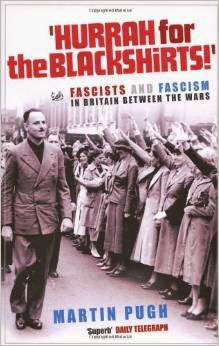
Book Review - Hurrah for the Blackshirts!: Fascists and Fascism in Britain Between the Wars

More of an in depth history of Britain between the wars.

Pugh's book is very thorough and well written. At times, his prose is very thick and somewhat hard going to read as he is a historian and writes in a dense scholarly matter. However, the writing is lively and active and it is not boring.

"Hurrah for the Blackshirts" is less of a story of Oswald Mosley, William Joyce, and others of that ilk and more of a socio-political history of Britain between World War I and World War II. Pugh goes into depth on various economic matters, political matters, bringing up hundreds of names and people in passing. Large sections of the book discuss current events of the time with little to no reference to any fascists at all. In fact, there is a chapter of the book that details British policy in India at this time which seems totally out of place. Pugh seems to realize this as well, seeing that he's thread-jacking his own book, he kept putting in throwaway references to Mosley through this particular chapter with such phrases like "Mosley disapproved of this" or "Mosley agreed with that."

Luckily, the book gets back on track in the final chapters (the best) which really focus on the fascists. William Joyce (the Infamous "Lord Haw-Haw" is only mentioned in passing with other fascists but Pugh really focuses on Oswald Mosley and much can be learned about him here. While making no conclusions, Pugh portrays him as a self-absorbed playboy more concerned with building up his personal legend than actually trying to make fascism happen in Britain.

A personal observation of mine though is that, like most 'mainstream' historians, Pugh totally ignores the pseudo-religious background to most of the fascist movements of Europe. This has been written about by such writers as Dusty Skylar and historians such as Nicholas Goodrich-Clarke. Even art historians such as Johnathan Meades talk of it. The Nazis especially were highly influenced by their strange own occult beliefs that convinced them of the demonic in-humanness of their victims and allowed them to slaughter them all the more because of it. 


 Pugh sidesteps these beginnings although refers in a number of occasions to the "romantic nationalist ideas" of National Socialism and fascism in general. While Pugh and others may see the idea of the Aryan descending directly from heaven and inhabiting Atlantis among the "beast-men" as ridiculous (which it is), these ideas did in fact make these fascists do what they did. 

Himmler and Hess were fundamentalist believers in their occult view of the world, a view which, while ludicrous, made them do the crimes against humanity which they did. Simply pretending that the pseudo-occult motivations of the Nazis and other fascists didn't happen because its too weird is just Pugh being careful among his fellow mainstream historians.

Friday, August 8, 2014

Book Review - To Die For Germany: Heroes in the Nazi Pantheon by Jay W. Baird


A book with a split personality.
This book is well written and is an easy and good read. It seems to actually be two books in one though. The first part of the book is indeed about Nazi "heros" who were killed early on in the Nazi Movement in Germany such as Horst Wessel the Ur-Skinhead (I think he is who Elton John's song about Saturday night is alright for fighting is written about) and the sixteen "immortals" who were gunned down during the abortive attempt to overthrow the Government of Bravaria in 1923.

Each chapter contains an account of a different subject, however, after a few chapters, the book suddenly changes content and tone. The middle and final chapters are no longer about Nazi's who died but goes over to talking about Nazi aesthetics, poetry, and propaganda. Indeed, there are pages and pages of Nazi poetry about death and mother's loss until you start getting weepy-eyed for the fallen German SS soldiers. It snaps me back to reality though when I realize these SS soldiers that Baird's presentation of poetry are getting me weepy about would have gladly and happily killed me as an untermench had they come across me in their conquests.

All in all a very good book. Baird's emotional portrayal of the Nazi cult's embracement of death in all their arts (with pages and pages of tear-jerking Nazi poetry) will make you reconsider and think. And that's the best thing a book like this can do, break you down, make you consider once again: Was this period of history really that bad? Were we right in resisting the "noble" and "mother loving" Nazis? Did they have a point sending their einsatzgreuppen against the Jews and Slavs and everyone else they didn't like? Some say its dangerous to think those thoughts. I personally do not because I always come down on the side that the Nazis were pure evil if for no other reason that I personally would have been the first they shot or threw in their ovens had they come across me.

Thursday, August 7, 2014

Book Review: Unholy Alliance: A History of Nazi Involvement with the Occult by Peter Levenda

More like "The Occult's Involvement with the Nazis"

This is an interesting book but it must be said that the cover and the title are a little misleading. Levenda does talk quite a bit about the Nazis and their occult movement. However, great swaths of the book recount general occult societies' history through the 20th century. Levenda lavishes chapters on Aleister Crowley (who Lavenda seems to think influenced almost every event in the first part of the century).

One further thing must be said about this book. Levenda approaches his subject from a number of assumptions. Assumptions that many people would call conspiracy theories. For instance, to Levenda, Martin Boremann's survival and escape to South America is not a theory but a fact. Levenda reminds the reader on several occasions that Boremann escaped to South America in the guise of a Catholic priest and with the help of the Catholic church. The fact that DNA testing in the early 1990s has pretty much overwhelmingly proved that Boremann died in Berlin in 1945 never comes into play.

The Catholic church does not come off well with Lavenda and he adds the fact that they were allied to the Nazis from the start (another "fact" Levanda accepts as gospel) to the many recent charges against them. Another "fact" is that Crowley was a British MI5 agent from WW1 and through WW2, actively working with the British government. These and other "facts", some just not well documented to others which are pretty much the territory of Conspiracy Theorists, really increase the "grain of salt" factor of the book.

Levenda, not a historian but some manner of journalist who spend most of his life investigating the occult, really knows his stuff though. Much of the text are obscure and phantasmagorical occult references to societies and personalities long forgotten and dead. Charles Manson gets a good airing as does LeVay, founder of Satanism. He does try to tie it all back to Nazi Germany in the first part of the book. Helena Blavatsky is fingered as one of the founding influences for Naziism, which she probably was.

Even for all the wild VonDaniken-esque ramblings and heapings of "facts", this book is a really good read. Lavenda's story of how he tried to penetrate a secret "Nazi" compound in Chile (which indeed is there and in which the Chilean dictatorship of the time did carry out very gruesome acts) is very gripping. Whether or not Martin Boreman and every other unaccounted for Nazi was hiding there at the time is really up for debate though. Its also good if you are up on your occult knowledge to know some of what Levenda is talking about. I recommend this book but go into it as a book written by an occultist with an axe to grind, not as a history written by an academic.

Wednesday, August 6, 2014

Book Review: Hitler and the Power of Aesthetics by Frederic Spotts


I bought this book in a batch with several others and didn't read it right away. From the title I was expecting something very dry, very boring, very thick.

Boy, was I wrong!

First off, in the introduction, Spotts starts off strong, talking about how his book has been required reading in universities AND neo-nazi forums and websites. He talks about how he has been accused of being a Nazi apologist, or maybe even more... His work has been misunderstood and even used to show people how aesthetic opinions and value can change once the provenience of a work is known (he mentions someone shown a Hitler painting saying that its okay and a good quaint try by a beginner recoiling in horror when told who drew it!). But most of all, Spotts writes with incredible humor, tongue and cheek, spearing Hitler, the Nazis, and even art critics with barbs and jabs through the text which frequently made me laugh out loud! And that's just the introduction...

The book is very long, I warn you. It is "thickly" written... Spotts is an academic and will expect you to digest difficult ideas with sometimes convoluted sentences. He writes from the assumption that you already have a nodding familiarity with aesthetics, art history, art criticism, and WW2. Oh, he does explain things and gives some background but he does not spend much time on it. This is something I personally like because it bores me to death when a historian feels the need to digress for ten pages to explain something s/he just introduced until I have forgotten what the original point is!

Pictures! There are pictures on almost every page! This is something I totally love about this book. Even in the paperback copy, there was practically a picture on every page about something being talked about in the text. For this alone, I highly recommend this book.

Everything is covered in this book. Architecture, paintings, movies, even how Hitler got involved with the creation of the Volkswagen. The looting of valuable art by the Nazis is given in such detail that I had to skip through lengthy lists of artworks stolen by the Nazis (the overwhelming amount of data probably included by Spotts just to give an idea of the enormity of the deed).

And through it all Spotts will remind you of who's side he's on as he wryly snipes at the Nazis with entertaining quips and comments. Other armchair generals and historians have launched offensives against the Nazis in the areas of Nazi military stupidity, propaganda and their horrible war of extermination against the Jews and everyone else they didn't like. Many historians and documentaries try to make a meal of Hitler's initial failings in Vienna trying to get into the art school with many a wispy "what if..." Spotts will have none of that. I don't have the direct quote at hand but you'll know it when you read it because it made me guffaw... words to the effect that Hitler just sucked! This book truly is an art historian's offensive against the Nazis in support.

In all, I highly recommend this book to anyone interested in art history, World War 2, and the Nazis. It took me a long time to get through it, its lengthy and densely written at times, but its entertaining and even uplifting. Spotts holds back no punches in showing you not only in what the world lost but also the horror of what almost came to pass... and that's when its uplifting because you close the covers of the book and realize, even just in the art world alone, how lucky we all are that the Nazis failed.

Tuesday, August 5, 2014

Book Review - The Secret Army: The IRA by J. Bowyer Bell


A Definitive Work!
This is, or was, the definitive history of the IRA. Begun in 1974, this book had been constantly revised and updated by the author up until his death in 2002. Unfortunately for us, this means that this book was no longer updated with the most recent events such as the ongoing peace process and activities of breakaway groups such as the "New IRA" are not covered.

Its well written, although there are a number of bizarre run-on sentences and fragments which seem to be mistakes in editing. There are no pictures at all, at least in this edition. Not even a central photo section. The text itself is very informative and this book really is cited by almost every other history or book written about the IRA. It is really a necessary basic source for anyone wanting to really dig into the subject.

While Bell is not Irish himself, he seems to approach the subject fairly, portraying all sides in the conflict objectively. Or at least as much as possible. When the text gets to the modern era, he is critical of everyone, including the British Army, for all the pointless killing and bombings which occurred. Since the text ends with the Good Friday Agreement of 1997, Bell ends his work in a hopeful "we'll see" for the future of Ireland. As Bell passed away soon after, he could give no further analysis of the situation and for that, the student or reader will have to find more current histories. One thing for certain though, those histories will cite this work as a source.

I started reading books focused on one area or another of recent Irish History, the Civil War, the Anglo-Irish War, even a book on the Border Campaign of the late 50s early 60s. However, looking back at it, I would go so far as to say that anyone who wants to get into the history of the Troubles or recent Irish history, should start with this book first. The overview is invaluable.

Monday, August 4, 2014

Book Review: Irish Secrets by Mark M. Hull

 
Mostly about espionage, avoids too much concentration on the IRA-Germany connection.


This was a really good book! Well written, packed with information, its main focus is on the activities of the Abwehr in Ireland from just before World War 2 through the entire conflict. I wanted to read this book as I had seen a documentary on TV about the collusion between the IRA and the Germans during WW2 (plan Kathleen). 

While the book does talk about Plan Kathleen and does mention the IRA, the author avoids too much discussion about the IRA itself. Most of the attention is on the individual German agents who are drawn colorfully and showing all their failings. It seems Ireland wasn't very high on Canaris' list and he didn't send very good agents there. The fact that he was probably trying to sabotage his own plans (some say Canaris was working against the Nazis or at least ambivalent about them) explains why he sent out such obviously poor agents.

The book gives a lot of information on espionage itself, the use of codes, signals, the "book code" and background such as that so it is a more of a history of espionage in the 20th century than about Irish internal politics.

I definitely recommend this book to anyone interested in Irish History of this period, espionage, propaganda, or World War II history. Its well and lively written with plenty of photographs throughout.

Sunday, August 3, 2014

Book Review: The 12th Planet by Zecharia Sitchin

Is he playing pool with planets?

 Sitchin's theory reminds me of an episode of the British comedy "Red Dwarf" where Dave Lister (the main character) causes one planet to hit another to fill in a white hole (using the interface of a pool table shot to do it). Only, Marduk/Nibiru's shot was a glancing shot that shot Earth into orbit, caused the asteroid belt and (to borrow again from Red Dwarf) "shot Marduk off the table and into someone's pint of beer."

I love reading about phenomenology, the occult, the paranormal, ancient astronauts, etc. However Sitchin is just a little bit too far for my tastes. And I think I know why. Born in the early part of the 20th century, Sitchin's "scientific" terminology and knowledge is just too dated for modern readers. Anyone with even a nodding education in physics or astronomy knows that his theories are ludicrous. But its not so much that Sitchin is an idiot but that he is a product of his times. Its like the 19th century physicists or modern occults use of the term "magnetism." It doesn't mean what the modern scientific definition of magnetism is. This is how Sitchin is with terminology like "radiation." I do not think Sitchin means the same thing that we, in the post-atomic age, know as radiation (visible light, gamma radiation, microwaves, the spectrum, etc etc).

Indeed, Sitchin has that quaint early 20th century idea that all radiation is good radiation. Nibiru didn't need the sun in the depths of space because it had its own "radiation" to keep it warm (kind of like a microwave!). I guess Sitchin never heard that, except for a very narrow band, most radiation is very very bad for organic life.

Wrapping your head around Sitchin's cosmology isn't just a stretch, its a rip. But if I was going to try, I'd say the closest anyone else has ever got to Sitchin's idea for Nibiru was Brian Aldiss' "Helliconia" series which postulates a planet with extreme climactic eras because of being in a double sun system. Could Nibiru's radiation keep something warm for 2,000 years of deep space? Oh sure, I can imagine silicon based lifeforms that could be bathed in microwave radiation like we sunbathe... make a good episode of Doctor Who, I bet!

Saturday, August 2, 2014

Book Review: The Ancient Alien Question by Philip Coppens

The Ancient Goblin Universe


Unfortunately, Philip Coppens passed away last year. I always enjoyed seeing him on "Ancient Aliens" as he seemed to be well spoken and rather level-headed. His book really bares that out as well. While writing about the "Ancient Alien Question" which many might find nonsensical, the realms of fantasy, Coppens approaches his subject very calmly. He does not rant and rave but builds up his case, talking about Carl Sagan's book "Contact" proves to be a 'Chekhov's gun' for his conclusions in the end.

His conclusions are equally as surprising and interesting. There have been many writers I have read that feel that any phenomenology around us is caused by invisible intelligences that have always been around. John Michael Greer writes of magickal or occult intelligences from different levels of being (that we mistake as UFO aliens). For John Keel and Ted Holliday, monsters such as the Loch Ness Monster are either spiritual remnants or evil demonic beings who wish us harm.

Coppens comes down in a similar belief in his conclusion. While it is possible that aliens have physically been here on planet earth, he is skeptical of it. Of all the thousands of reports, he feels it could have happened only about four times and only then accidentally. Coopens does not think any aliens came here to mine our planet or genetically engineer us. However, Coppens theory is that there have been frequent non-physical contacts with "alien" intelligences throughout time. Either through shamans or ceremonies or accidentally through the use of various ceremonies and drugs, people have contacted extra-dimensional beings, or perhaps just aliens on their own worlds. This is where any "ancient alien" influences on ancient civilizations occurred. Its a theory I have seen in UFO and Cryptological literature frequently but this is the first time I have encountered it in regards to the Ancient Alien Theory.

Thursday, July 24, 2014

The Author Strikes Back!

Some time ago I read a book called "Showa Japan: The Post-War Golden Age and its Troubled Legacy" by Hans Brinkmann.  I liked it although I didn't agree with everything in it; I rarely agree totally with anything or anyone.  Like a famous actor said once "I always have reservations..."

Some time later I got a notification that someone responded to my review on Amazon.  It was the author himself!  He was somewhat miffed at some things I said and somewhat confused because I gave a mixed review in which I still recommended his book.  I was really startled though.  I've never had an author of a book read one of my reviews before, let alone respond.  I felt so important!

Hope he didn't see the YouTube video I made of that book's review.  Hey, I still said he liked it.  I just knocked him really hard about calling the Japanese "infantile" because they like cosplay.  Okay, so maybe cosplay is a little bizzare to some, but infantile?  I don't think so.

You can read my review for the book (and the author's response) at: My review: Showa Japan


You can see my YouTube review of it at:  YouTube review: Showa Japan